
For anyone planning their first African safari, safety questions come early and come often. South Africa’s reputation in international media can be genuinely confusing headlines about urban crime sit alongside award-winning tourism campaigns and glowing traveler reviews. The honest answer is that these two realities coexist, and understanding which one applies to your actual trip makes all the difference.
South Africa welcomed 8.92 million international tourists in 2024, according to Statistics South Africa, with the vast majority experiencing trouble-free visits. For first-time safari travelers specifically staying in organized, managed reserves the safety picture is considerably better than the headlines suggest, and meaningfully better than many of Africa’s other major safari destinations.
This guide is written for people planning their first safari who want honest, practical answers.
The Urban vs. Safari Safety Distinction First-Time Travelers Need to Understand
The most important thing to know before researching South Africa’s safety is that “South Africa” covers two very different travel experiences.
South Africa’s major cities Johannesburg, Cape Town, and Durban do have elevated crime rates by international standards. Petty theft, vehicle crime, and opportunistic crime in urban areas are real considerations that credible travel advisories from the US State Department, UK Foreign Office, and Canadian government all note. Travelers in cities should practice the same heightened awareness they would in any major metropolitan area: keeping valuables out of sight, avoiding unfamiliar neighborhoods after dark, and using reputable transportation.
Safari environments operate in an entirely different context. Private game reserves and national parks are removed from urban crime patterns. Access is controlled, staff are present around the clock, and the closest thing to a safety concern is following your guide’s instructions around wildlife. Travelers who fly or drive directly from the airport to a safari lodge bypassing extended time in city centers experience a fundamentally different safety environment than the headlines describe.
This urban-rural distinction is the single most important clarification for first-time safari travelers researching South Africa.
What Makes South Africa Particularly Beginner-Friendly for Safari
Beyond the safety question, several practical factors make South Africa the most accessible first safari destination on the continent.
English is the primary language of tourism. South Africa has 11 official languages, but English is spoken throughout the tourism industry. Safety briefings, game drive explanations, emergency communication all of it happens clearly and without translation barriers. This is not always the case in East African destinations, where language gaps can add stress for first-time international travelers.
Infrastructure meets international standards. Roads, medical facilities, domestic airports, and telecommunications in South Africa are among the most developed in Africa. The US Federal Aviation Administration rates South Africa’s civil aviation authority as meeting international safety standards. Private safari lodges typically operate on generator or solar backup power, insulating guests from the load shedding (scheduled power outages) that can affect other parts of the country a practical consideration worth confirming with your lodge before booking.
The country is visa-free for most Western passports, including US, UK, Canadian, Australian, and EU citizens for stays up to 90 days. No special vaccinations are required for entry into most safari regions, and unlike many African destinations, the Waterberg, Madikwe, and Eastern Cape safari areas require no antimalarial medication. This reduces the logistical complexity and pre-trip medical preparation that East African safaris require.
Direct flights from the US land in Johannesburg. Delta operates nonstop service from Atlanta (ATL) and United from Newark (EWR), meaning first-time travelers can avoid the multi-connection itineraries that characterize trips to Tanzania or Kenya. From O.R. Tambo International, malaria-free Waterberg safari destinations are a 3.5-hour road transfer with no domestic connecting flight required.
How Safari Guides Keep First-Time Travelers Safe Around Wildlife
Wildlife safety on a guided safari is one of the questions first-timers ask most. The answer lies almost entirely in the quality and training of your guide, and in following instructions consistently.
Professional safari guides in South Africa are required to complete formal certification through the Field Guides Association of Southern Africa (FGASA), which covers animal behavior, tracking, emergency response, and guest management. Experienced guides at reputable lodges spend years studying the specific animals and terrain of their reserve before leading guests independently.
Before every game drive, guides conduct a safety briefing covering the core rules: remain seated while the vehicle is moving, keep noise low around animals, never attempt to touch or feed wildlife, and follow guide instructions without delay. These protocols are not arbitrary they reflect decades of accumulated knowledge about how animals respond to vehicles and human presence. When followed, they virtually eliminate safety incidents on guided drives.
Safari vehicles are purpose-built for the environment. The elevated, open-sided design positions passengers above the direct sightline of most animals, which reduces the perceived threat response that ground-level encounters would trigger. Vehicles carry communication equipment maintaining constant contact with the lodge and other guides in the field, creating a real-time awareness network across the reserve.
First-time travelers often worry about being in open vehicles near lions or elephants. In practice, animals in well-managed reserves have been habituated to vehicles over many years and treat them as neutral objects in the landscape. The experience is observational rather than confrontational and your guide’s reading of animal body language and positioning is what keeps it that way.
Why Malaria-Free Safari Regions Remove a Significant Health Variable
For first-time safari travelers, especially those traveling with family, or those who’ve never taken antimalarial medication before, the health question can feel as daunting as the wildlife question.
South Africa is unique on the continent in offering certified malaria-free Big Five safari destinations. The Waterberg region in Limpopo Province, Madikwe Game Reserve, Pilanesberg National Park, and the Eastern Cape private reserves all sit outside the malaria transmission zone, due to their altitude, climate, and seasonal temperature patterns. No prophylactic medication is needed. No mosquito nets are required at night.
This matters practically for first-time travelers in several ways. Antimalarial drugs carry their own side effects nausea, vivid dreams, sun sensitivity that can affect the quality of your trip. They add cost ($100–150+ per adult for a standard course), which multiplies for families. And for children under certain weights, pregnant travelers, and people on other medications, some antimalarials are contraindicated entirely.
Malaria-free destinations remove all of this without any compromise to wildlife quality. The Waterberg, for example, supports the full Big Five across a landscape that includes open bushveld, riverine forest, and dramatic mountain scenery the same species composition as malaria-risk parks, at elevations that keep the environment naturally free of transmission risk.
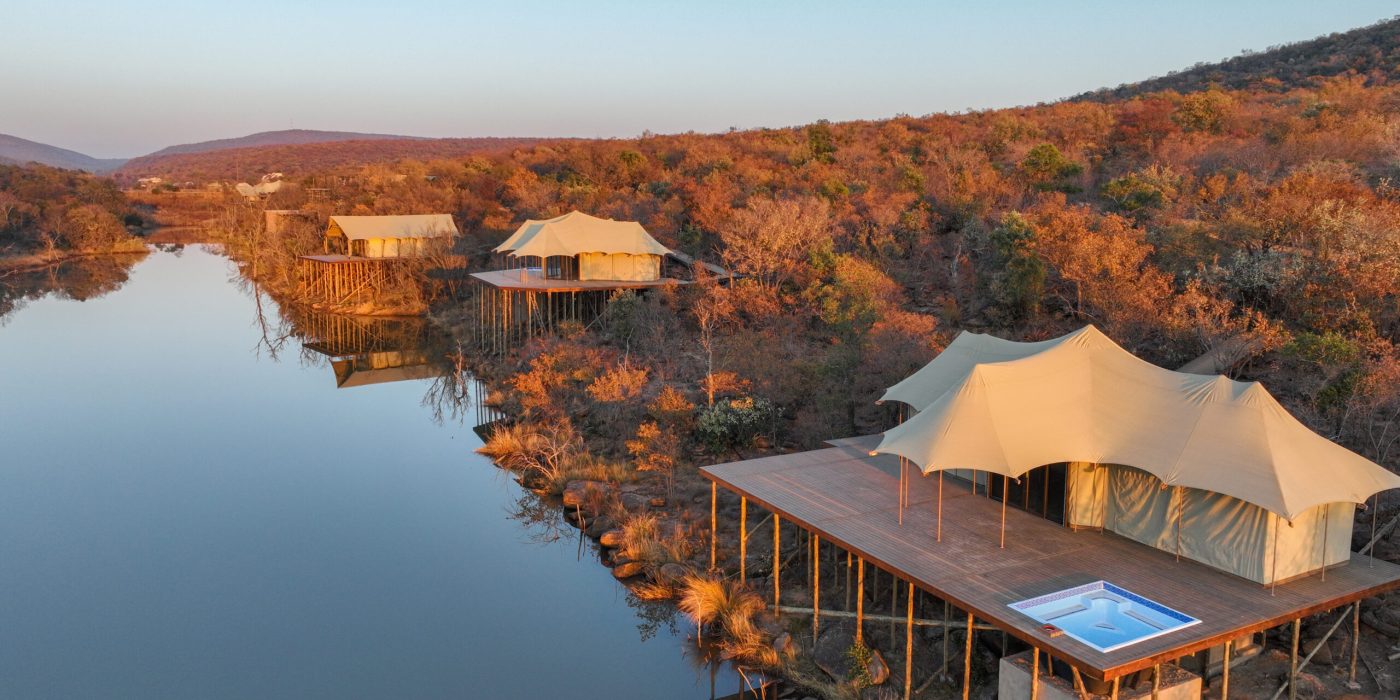
Hippo Lakes, situated along a lake bank within the Waterberg Biosphere Reserve, is one example of what this looks like in practice. The lodge holds a TripAdvisor Travelers’ Choice Award with 98% five-star reviews, a consistency that reflects the daily Big Five game drives, wildlife abundant around the lake, and the kind of open-air experience that’s only possible when mosquito-borne disease isn’t a factor. At Waterberg elevations, lodges can be genuinely open to the bush at night in ways that enclosed malaria-zone properties cannot be.
What First-Time Travelers Should Know About Safari Accommodation Safety
Modern safari lodges are designed with both wilderness immersion and practical security in mind. Quality lodges maintain controlled access, 24-hour staffing, and communication systems that keep guests connected to help at all times.
Accommodation at reputable lodges whether luxury tents, thatched chalets, or permanent suites features secure closures, insect screening, and lodge-wide power systems that typically include backup generation or solar capacity. The “roughing it” image of safari accommodation is largely outdated at established lodges; most offer amenities comparable to boutique hotels, with the bush as the backdrop rather than a compromise.
For first-time travelers specifically, the all-inclusive model common at private lodges is genuinely valuable. Meals, game drives, and activities are coordinated by lodge staff, removing the logistical decisions that can create anxiety in unfamiliar environments. You arrive, you’re briefed, and your schedule is managed allowing full attention on the experience rather than the planning.
Practical Safety Checklist for First-Time South Africa Safari Travelers
Getting the preparation right removes most of the uncertainty. Before departure, first-time safari travelers should address each of the following:
Travel insurance with medical evacuation coverage is essential for any safari trip. South African private clinics and hospitals typically require upfront payment from foreign visitors, and evacuation coverage ensures you’re not managing costs during a medical event. Confirm your policy covers safari activities and wildlife encounters specifically.
Consult a travel health clinic four to six weeks before departure, even for malaria-free destinations. Routine vaccinations should be current, and your doctor can advise on any destination-specific considerations based on your personal health history.
Confirm lodge power and connectivity before booking if these matter to your experience. Most established Waterberg and Madikwe lodges operate on solar or generator systems independent of the national grid, making load shedding a non-issue. Cell coverage varies by reserve worth checking if staying connected is important to you.
Keep city time minimal on arrival. If your concern is South Africa’s urban safety context, the simplest mitigation is limiting extended independent time in Johannesburg city center. The airport area’s hotel corridor (including the Intercontinental at O.R. Tambo) is considered safe and well-managed. A night there before driving north to the reserve is a common and comfortable itinerary for first-time visitors.
Dress for the bush, not the city. Neutral earth tones (khaki, olive, brown) are appropriate for game drives and make you less visually conspicuous to animals. Leave bright colors, heavy fragrance, and jewelry at home or in the lodge safe.
Is South Africa the Right First Safari for You?
For most first-time safari travelers, particularly those from the US or UK traveling with family, or those who want a high-quality wildlife experience without complex logistics, South Africa offers the clearest path to a successful first safari.
The combination of no visa requirement, no malaria risk in key reserves, direct international flights, English-language guiding, developed medical infrastructure, and world-class wildlife makes the entry barrier lower than any other Big Five destination on the continent. The urban crime context is real but mostly irrelevant to travelers who move efficiently from the airport to a managed reserve.
East African destinations like the Serengeti and Maasai Mara offer wildlife spectacles that have no equivalent the Great Migration being the obvious example but they require antimalarial medication, internal flights, higher logistical complexity, and typically higher cost. For a first safari where the goal is immersive Big Five wildlife in a safe, accessible environment, South Africa and the Waterberg in particular is the strongest starting point.
Frequently Asked Questions
Is South Africa safe for safari travel?
Yes, organized safari travel in South Africa is very safe. Private reserves and national parks operate in a fundamentally different environment from South Africa’s urban centers, which do have elevated crime rates. Game reserves have controlled access, trained guides, 24-hour staffing, and established safety protocols. Millions of international visitors complete South Africa safaris annually without incident. The US State Department’s travel advisory notes that tourism activities are generally well-regulated, with dangerous areas clearly marked and professional staff managing activities.
Do I need malaria tablets for a safari in South Africa?
It depends entirely on which region you visit. The Waterberg, Madikwe Game Reserve, Pilanesberg National Park, and Eastern Cape reserves are all certified malaria-free no medication is required. Kruger National Park carries low-to-moderate malaria risk and prophylactic medication is recommended, particularly during the summer months (November to April). If avoiding medication is a priority, malaria-free regions offer the full Big Five experience without that requirement.
What should first-time safari travelers know about wildlife safety?
Professional guides in South Africa hold FGASA certification and lead every game drive with established safety protocols: remain seated in the vehicle, keep noise low, never feed or approach animals, and follow guide instructions immediately. Animals in well-managed reserves are habituated to vehicles and do not treat them as threats. Safety incidents on guided drives are extremely rare. The critical rule is simple: trust your guide’s judgment and follow their instructions without hesitation.
Is South Africa suitable for families with children on a first safari?
South Africa’s malaria-free reserves particularly the Waterberg and Madikwe are among the most family-friendly safari destinations in Africa. No age-related medication restrictions apply, many lodges offer dedicated children’s programs, and the infrastructure (medical facilities, English communication, accessible logistics) is well-suited to family travel. Some lodges set minimum age requirements for game drives, typically around six years old, so confirm with your lodge when booking.
How should first-time travelers handle the Johannesburg transit?
Most international arrivals connect through O.R. Tambo International Airport in Johannesburg. The airport corridor and adjacent hotel zone are considered safe and well-managed many first-time visitors spend one night at the on-site Intercontinental or similar airport hotel before transferring directly to their safari lodge the following morning. Avoid extended independent exploration of Johannesburg city center on a first visit, particularly after dark. Once you’re in transit to a managed safari reserve, the urban context is largely behind you.
Is South Africa good for a solo first-time safari traveler?
Yes. South Africa’s safari infrastructure, English-language guiding, organized lodge programs, and group game drive format make it well-suited to solo travelers. Most lodges combine individual bookings into shared game drive groups, providing a natural social element. The malaria-free regions remove a logistical concern that solo travelers without a travel partner to share medical decisions with often find disproportionately stressful.