
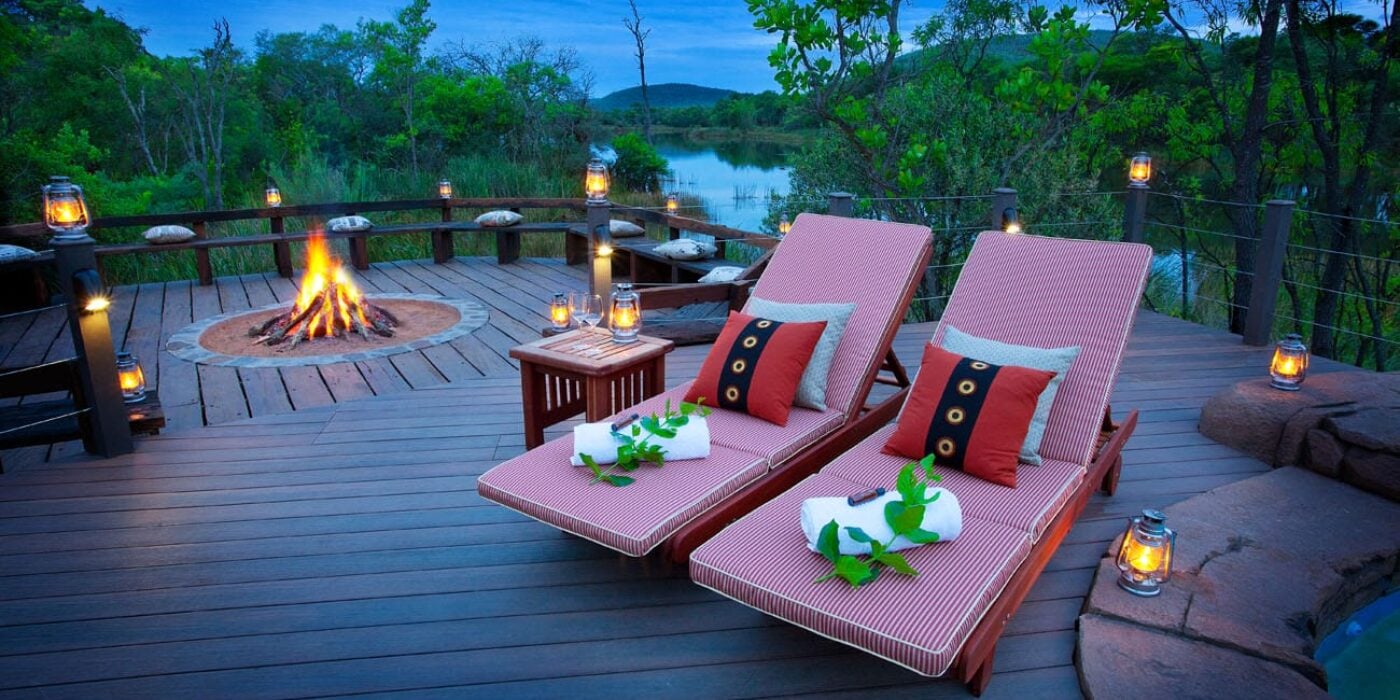
A day at Hippo Lakes follows a rhythm that Africa has set for centuries: early drives in cool pre-dawn air when predators are still moving, long midday hours on a lake bank where hippos surface and elephants come to drink, late afternoon game drives that end with sundowners atop Tabletop Mountain, and evenings around a hardwood fire under a sky with no light pollution. It is a complete day in the bush, structured around wildlife and light rather than a schedule.
Hippo Lakes sits on a private lake bank within South Africa’s Waterberg Biosphere Reserve, a UNESCO-designated wilderness in Limpopo Province that is completely malaria-free year-round. The lodge holds a TripAdvisor Travelers’ Choice Award with 98% five-star reviews, is 3.5 hours by road from Johannesburg’s international airport, and requires no visa, no malaria medication, and no vaccinations for US, UK, and Australian passport holders. Daily Big Game Drives to neighboring Waterberg reserves bring lions and elephants into the itinerary alongside the leopards, rhinos, hippos, buffalo, and giraffes resident on the property.
How a First Safari Day at Hippo Lakes Is Structured
Safari life follows the animals, not a clock. That means early starts, a long midday rest, and a second drive in the afternoon. For first-timers the rhythm feels unusual on day one and completely natural by day two. The most common thing guests say after their first morning drive is that they had no idea how much there was to see before breakfast.
Early Morning: Game Drive at First Light
Morning game drives depart in the cool pre-dawn hours when the Waterberg is at its most active. Predators like leopards are often still moving from overnight hunting, while hippos make their way back from grazing and herbivores head toward waterholes at first light. Your guide will brief the group before departure and cover what to look and listen for.
The drives run for several hours through varied Waterberg terrain: open bushveld, riverine corridors, and rocky ridgelines: in open 4×4 vehicles. Rangers carry deep knowledge of the ecosystem, pointing out animal tracks, bird calls, and behavioral cues that most guests would otherwise miss. Refreshments are served in the field, usually at a scenic stop where the group can step out briefly and take in the landscape.
Morning light in the Waterberg is exceptional for photography. The sandstone formations and valley mist create conditions that improve as the sun rises. Layering is essential regardless of season. Winter mornings (June through August) regularly drop to 42F, and even summer mornings start cool before daytime highs reach the mid-to-upper 80sF. Long pants, a warm jacket, closed shoes, and a hat cover every scenario. US travelers should note that South Africa uses Type M plugs: a plug adapter is needed for charging cameras and devices, and Hippo Lakes recommends packing one before departure.
Mid-Morning: Breakfast and the Lodge at Rest
After the morning drive, the lodge serves a full breakfast. Meals at Hippo Lakes are a proper event: gourmet preparation with local ingredients, served overlooking the lake. This is when the day’s sightings get discussed and plans for the afternoon take shape.
The midday hours are reserved for rest. Animals retreat to shade as temperatures rise, and the lodge slows to match. The lake comes into its own during this time. Hippos surface and submerge from the deck, elephants occasionally come to drink along the bank, and the birding along the shoreline is active throughout the day, with over 300 species recorded in the Waterberg. A fishing rod, a book on the deck, or a nap in the tent are all reasonable uses of the midday hours.
The tents themselves are worth describing for first-time safari travelers who picture roughing it. Hippo Lakes offers three accommodation categories: luxury, premium, and premier: all with heating and air conditioning (called “aircon” locally, with a sun symbol for heat and an icicle for cooling), heated blankets for winter, indoor showers and tubs, power, WiFi, and cellular connection. One practical note: the reserve has resident Vervet monkeys that will enter an unlocked tent and cause considerable chaos. Keep doors closed and locked whenever you leave.
Optional activities during this window include guided bush walks, where rangers cover the smaller details of the ecosystem: insects, plant life, tracks, and nests: that vehicle drives move past too quickly to appreciate. Fishing is available from five dedicated decks around the lake, with tackle provided.
Afternoon: High Tea and the Evening Drive
Around mid-afternoon the lodge serves high tea before the second game drive departs. Eat something: dinner won’t be until after dark.
The afternoon drive takes advantage of cooling temperatures as animals become active again. The light shifts quickly in the Waterberg late afternoon, moving from flat white into deep gold, which makes this the better of the two drives for photography. Wildlife behavior changes too, as predators begin positioning for the evening.
The signature moment of the afternoon is sundowners atop Tabletop Mountain. Guides navigate to this elevated vantage point where guests watch the sun go down over the Waterberg with drinks and snacks, panoramic views stretching across the reserve in every direction. It is consistently the moment guests mention when describing the trip afterward.
The drive back to the lodge in fading light brings its own encounters as nocturnal animals begin to stir.
Evening: Bush Braai Under the Stars
Back at the lodge, there is time to freshen up before the evening meal. Hippo Lakes serves a traditional bush braai: South African cuisine prepared over hardwood coals, eaten outside under open sky. The hippos are audible from the lake. Bush babies move through the trees. The Waterberg’s minimal light pollution makes the Milky Way visible on clear nights in a way that most guests have never seen it.
The communal atmosphere of the braai is where the day’s sightings get properly compared and the conversation runs long. Safari days wind down early by necessity: the next morning drive comes around quickly, and the early start is where the best wildlife moments tend to happen.
As one guest described it: “With Hippo Lakes, every day felt effortless, yet extraordinary. I couldn’t imagine doing it any other way.”
Extending Your Trip Beyond the Waterberg
Hippo Lakes offers curated extensions that connect directly to the safari itinerary for travelers who want to see more of southern Africa. Current options include Cape Town tours (two to five nights covering Table Mountain, the Cape Peninsula, Boulders Beach penguins, and the Winelands), a Victoria Falls Discovery (two nights on the Zimbabwean side with a guided walk to the falls and a Zambezi River sunset cruise), and a Namibia Horizons journey (six nights covering Swakopmund, the Skeleton Coast, and Sossusvlei’s dunes). Each extension is managed through Hippo Lakes’ US concierge and local support teams, with handpicked hotels, private vehicles, and professional guides throughout. All extensions connect seamlessly before or after the Waterberg safari stay.
Ready to experience it for yourself? Contact the Hippo Lakes team to check availability and discuss your dates.
Frequently Asked Questions
What time do morning game drives start at Hippo Lakes?
Morning drives depart in the early pre-dawn hours to catch the most active period for wildlife. The Hippo Lakes team will confirm exact timings when you book, as departure times adjust slightly by season based on sunrise and conditions.
What wildlife can you see at Hippo Lakes?
The reserve supports leopards, buffalo, giraffes, rhinos, wildebeest, kudu, sable, eland, nyala, hyenas, and wild dogs, with hippos resident on the lake and visible from the lodge. Big Game Drives to neighboring Waterberg reserves bring lions and elephants into the itinerary, covering the full Big Five spectrum.
Is Hippo Lakes malaria-free?
Yes. Hippo Lakes is located in the Waterberg region, which is certified malaria-free year-round due to its altitude and climate. No antimalarial medication is required at any time of year.
What makes Hippo Lakes different from other safari lodges?
Hippo Lakes sits on a private lake bank in the UNESCO Waterberg Biosphere Reserve, which gives the lodge a setting most safari properties don’t have: resident hippos, lakeside dining, and deck wildlife viewing throughout the day. The lodge operates in small, exclusive groups with guides that are not available through standard booking channels, and US travelers have access to a dedicated US concierge team alongside local on-the-ground support. Specific features include sundowners atop Tabletop Mountain, traditional bush braais, Big Game Drives to neighboring reserves for lions and elephants, five fishing decks, and three accommodation categories (luxury, premium, and premier). The TripAdvisor Travelers’ Choice Award and 98% five-star review rating reflect the consistency of the experience across all of these.
What should you wear on safari at Hippo Lakes?
Neutral-colored, layered clothing in khaki, olive, or beige works for all drives. Winter mornings drop to around 42F and summer highs reach the mid-to-upper 80sF, so layers that can be added and removed across the day are more practical than a single outfit. Long pants, a warm jacket, closed-toe shoes for bush walks, a wide-brim hat, sunglasses, and sunscreen cover the essentials. Binoculars (one per person), a camera with spare memory cards, and a US to South Africa Type M plug adapter round out the practical list. The lodge supplies shampoo, conditioner, body wash, and soap. Leave bright colors, strong fragrance, and valuables at home.